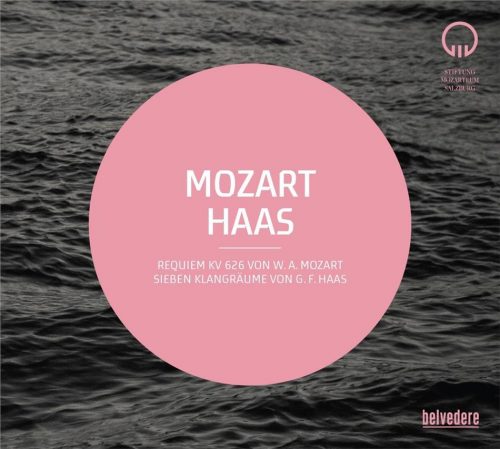
Alto: Dame Sarah Conolly
Tenor: Topi Lehtipuu
Bass-baritone: Alastair Miles
Organ: Anton Holzapfel
Choir: Salzburger Bachchor
Orchestra: Mozarteum Orchester Salzburg
Conductor: Ivor Bolton
Date: 2015
Venue: Great Hall of the Stiftung Mozarteum Salzburg
Cat No.: BVE08047
Released: 2019
In terms of the Mozart, you hear the movements from the ‘Dies irae’ to the ‘Hostias’ in skeletal form, with the eight Mozartian bars of the ‘Lacrymosa’ left hanging in mid-air. You are left marvelling, on the one hand, that so much of the work was complete in Mozart’s head, waiting to be written down. The continuity is all there, so far as the score exists; all that is missing is the colouring-in. Then you are struck by the fearsome task of completion that faced the 25 year-old Süssmayr early in 1792. The ‘Dies irae’ thins out as it goes along; the ‘Tuba mirum’ – following the trombone solo – exists largely as just vocal lines and bass. The re-entry of basset-horns for the ‘Recordare’ and ‘Confutatis’ comes as colouristic balm.
There are some oddities, though. Bolton presents the ‘Kyrie’ in its fully orchestrated form, although Mozart composed only the choral and continuo parts. The organist, too, far from merely providing discreet harmonic filling, sometimes inserts snippets remembered from the later, completed version: for example, at ‘Statuens in parte dextra’ in the ‘Recordare’. If the aim was to demonstrate how much or how little was by Mozart, it defeats the point then to smuggle in bits of Süssmayr.
Haas’s Klangräume adopt the choral and unusual instrumental forces of the Requiem and offer commentaries on its fragments in a somewhat Ligetian style. There are clusters, slow falling tutti glissandos, speech and Sprechstimme, setting words from a 1791 letter appointing Mozart to the unpaid post of deputy Kapellmeister at St Stephen’s Cathedral. A balance that favours instruments over choral voices works better here than in the Mozart; you will notice ideas from the corresponding movements of the Requiem being taken up and refracted through Haas’s 21st-century prism in each Klangraum.
Another puzzle is why it took 13 years for the recording to see the light of day. Worthwhile for the Haas, for those attuned to his sound world. Another recording of the Requiem fragment (Naïve, 5/02) exists, sans Haas, and is now available in Universal’s majestic ‘Mozart 225’ collection (10/16).
David Threasher on Gramophone.
David Vernier on ClassicsToday.com, July 2019